The GTM Platform Is Emerging
Why the next major B2B software category may be the system that connects market signal to revenue action
For the past decade, B2B companies have built their go-to-market stacks one problem at a time. Need account data? Buy a data provider. Need intent? Add an intent platform. Competitive intelligence, sales enablement, sequencing, call intelligence, win-loss, attribution, forecasting, enrichment, ABM and customer success each grew their own vendors and systems of record.
Each purchase made sense on its own. Together they produced something much harder to operate.
Competitive evidence lives in one product, messaging in a document, buyer research somewhere else, account activity in the CRM, seller guidance in an enablement portal and customer conversations in a revenue intelligence platform. The company has the information. The problem is connecting it quickly enough to make a decision.
That is why a category is beginning to take shape: the go-to-market platform. It is also the problem Segment8 is built around.
The term is still loose. To some vendors a GTM platform is a buyer intelligence system; to others it is an outbound automation engine, a data orchestration layer, a revenue operating system or an AI workflow platform. That ambiguity can make the category look unserious. But the lack of agreement may be exactly what an emerging category looks like before its boundaries settle.
The stack is starting to collapse back together
Categories emerge when problems once considered separate start to look like parts of one larger problem. Vendors expand beyond their origins, customers consolidate workflows, analysts draw broader boxes, and eventually the market shares an expectation of what the category does.
There are signs this is already happening. Gartner Peer Insights now maintains an AI GTM Platforms category, covering AI support for marketing, sales and customer success across the GTM lifecycle. More telling is that vendors with very different histories are moving towards the same territory:
- Clay began as a flexible enrichment and workflow tool. In July 2026 it said it was evolving into an "end-to-end orchestration platform for go-to-market", with a longer-term vision of a revenue engine that remembers which efforts worked and recommends what to do next. (Clay's 2026 roadmap)
- Common Room built around buyer signals and now describes itself as an AI-native GTM platform for buyer intelligence and action. In July 2026 Zoom agreed to acquire it, joining buyer intelligence to the place where customer conversations happen.
- Apollo is approaching from prospecting and execution. Its March 2026 acquisition of Pocus was framed around building an AI-native GTM operating system that detects signals, prioritises accounts and guides execution in one place.
- Demandbase is moving out from ABM and intent. Demandbase One now unifies data, signals and execution across marketing, sales and advertising, and is positioned as a pipeline engine for GTM.
- Gong has grown from conversation analysis into forecasting, engagement, enablement and automation, and now describes a "Revenue AI Operating System".
- Copy.ai may be the clearest case of category migration: from AI copywriting to reusable GTM workflows combining research, content, integrations and agents.
- Segment8 is approaching from the work between market understanding and field execution, connecting competitive intelligence, win-loss, messaging, buyer research, launches and seller guidance into one workflow.
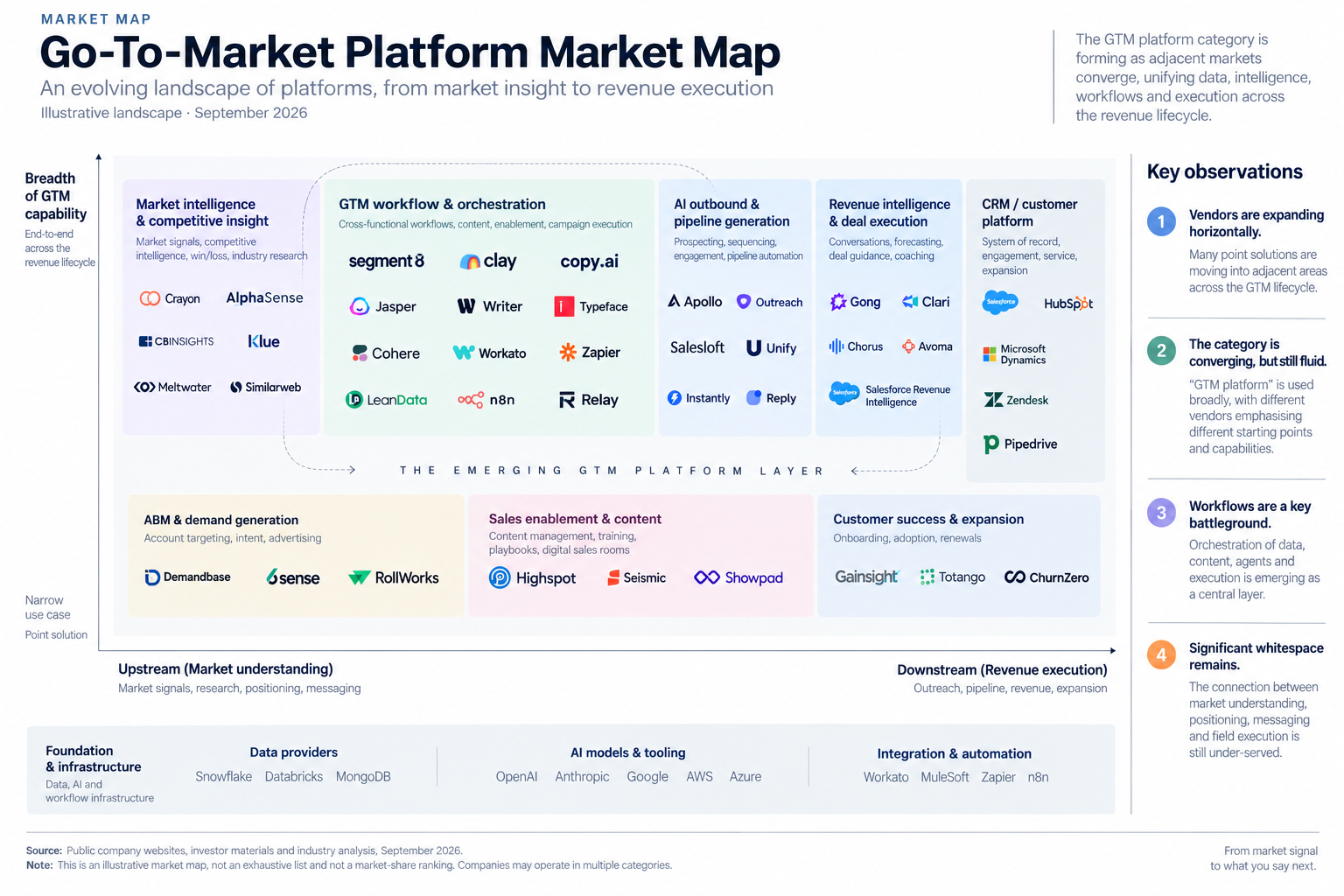
These products are not substitutes for one another. What they share is a belief that the next valuable layer of GTM software is broader than the specialist category each began in.
AI changes the natural boundary of software
First-generation SaaS could afford to be narrow because humans supplied the missing context, moving between applications, attending meetings and connecting the dots.
AI changes that, because an intelligent system is only as useful as the context it has. If it knows a prospect's email and job title, it can automate a task. If it also understands the account, recent behaviour, customer history, competitive situation, approved messaging and past deal outcomes, it can start to participate in a decision.
So the unit of automation shifts from the task to the workflow, and then to the operating loop: the system identifies why an account matters, decides on a response, retrieves the relevant company knowledge, acts, and learns from the result. Common Room describes a similar progression in its thinking on AI-native GTM: from intelligence alone towards intelligence, orchestration, governance and execution. Once that is possible, the old category boundaries start to look arbitrary.
The real battle is over the control point
The useful question is not who belongs inside a box marked "GTM platform". It is: what does each company believe should sit at the centre of go-to-market?
- Clay: data and orchestration
- Common Room: the buyer
- Demandbase: the account, and coordinated action across marketing and sales
- Apollo: the prospect and the motion around them
- Gong: the revenue interaction
- Copy.ai: the GTM process itself
- CRM and customer-platform vendors: the customer record
- Segment8: the GTM workflow around a decision
These are not just competing feature sets. They are competing theories of how a GTM organisation should operate, and the category battle will be about which one becomes the control point everything else is organised around.
The missing layer sits upstream
Most emerging GTM platforms are weighted towards the downstream side: which account to target, who to contact, what signals matter, what the next action is, what happened on the call, how healthy the deal is.
But those questions begin late. Before a seller acts, something has already changed in the market. A competitor launched something. An objection kept recurring. Win-loss research revealed a pattern. Messaging stopped landing. Someone has to interpret that, decide whether it matters, choose a response and get it to the people talking to customers.
That upstream loop is remarkably fragmented. Market evidence sits in a CI tool, win-loss findings in research decks, personas in a document, messaging somewhere else, launch plans in their own workspace, seller guidance in an enablement portal, deal outcomes in the CRM, and the moment everyone agrees what to say happens in Slack.
The organisation has no obvious operating layer connecting what it learns to what it decides, and what it decides to what its people say and do. That suggests another candidate control point: the GTM decision.
That is the gap Segment8 is built around: a workflow layer connecting the evidence, ownership, decisions and outputs involved in taking a response from market signal to seller action. Competitive intelligence is one source of context inside that workflow, not the whole product.
Two loops, and a platform that connects them
Consider a process that starts with a market signal rather than a prospect signal:
Market signal → evidence → interpretation → decision → message → execution → outcome → learning.
Set that beside the loop most GTM software serves today:
Buyer signal → account prioritisation → outreach → opportunity → revenue.
The first tells an organisation what it believes and how it should respond. The second tells it where the demand is. A mature GTM platform will probably have to connect them.
Competitive intelligence, buyer research, win-loss, positioning, launches, messaging and seller guidance have long been treated as adjacent disciplines. From the perspective of the operating loop, they are stages of one process. The product marketing stack looks less like a set of separate applications and more like an unfinished GTM operating layer.
What the category needs to become real
If every piece of sales and marketing software calls itself a GTM platform, the phrase will mean nothing. CRM, marketing automation and revenue intelligence each became categories because buyers came to expect a consistent set of capabilities. For GTM platforms, those are likely to be:
- Shared context, not just the objects one department owns.
- Cross-functional workflows across marketing, sales, product marketing, RevOps, enablement and customer teams.
- Decision support: helping a human or agent decide what happens next, not merely retrieving information.
- Execution: getting the decision to the people and systems that can act on it.
- A learning loop, so outcomes improve the next decision.
- Governance and provenance.
The last may matter most. As AI does more GTM work, organisations will need to know where an answer came from, what evidence supports it, whether it was approved, what changed and who owns it. Generating a plausible answer is becoming cheap. Generating one an enterprise will put in front of a customer is much harder.
Why now
Three forces are converging:
- Stack fatigue. Years of specialist tools have made the whole system hard to operate. Common Room explicitly names fragmented data and tool sprawl as the problem it targets.
- AI's hunger for context. Point solutions thrived when humans connected them. AI is far more useful when it sees the relationships between accounts, conversations, research, messages and outcomes, which gives platforms an economic incentive to own broader context.
- Organisational change. Companies increasingly treat GTM as one commercial system rather than separate marketing, sales, enablement, RevOps and success machines. Once leadership asks how the GTM system performs, it is natural to ask what it should run on.
Three futures
None of this guarantees a durable category.
- An umbrella term. "GTM software" becomes useful the way "martech" is: a description of a large set of technologies, not something anyone buys as one thing.
- Absorption. CRM, revenue intelligence, ABM and sales platforms widen, and "GTM" stays positioning language.
- Deliberate consolidation. Buyers consolidate previously separate systems around a new operating layer. If so, the winner is the vendor that owns the most valuable control point: the buyer, the account, the customer record, the workflow, the revenue conversation, the market or the decision.
The category thesis
A GTM platform is not a giant application containing every sales and marketing feature ever built. That would just recreate the old stack inside a bigger box. A better definition:
A go-to-market platform connects what an organisation knows with what it decides and what it does next.
It links signals to context, context to decisions, decisions to workflows, workflows to sellers and customers, and outcomes back to learning. Clay approaches it from data and orchestration, Common Room from buyer intelligence, Demandbase from accounts, Apollo from prospecting, Gong from conversations, Copy.ai from workflow automation and the CRMs from the record. Segment8 approaches it from the layer emerging upstream: the workflow that turns market, buyer and deal intelligence into coordinated GTM action, connecting competitive evidence, win-loss, messaging, launches and seller guidance to the people responsible for changing them.
The boundaries are still moving and the category is unfinished. But the question is no longer whether GTM software will become more connected. It is where the centre of gravity lands, because the company that owns that point may own something more important than another component in the stack.
It may own the place where the stack becomes a system.