
Go To Market work is fragmented across teams and tools. Product Marketing manages positioning and messaging. Revenue Operations manages deal outcomes in the CRM. Customer and Win-Loss research sits elsewhere. Launches are coordinated in project tools. Sales hears objections while the deal is moving.
When something changes, the work crosses all of those boundaries. Teams switch tools, chase owners, compare versions, and rebuild the context.
Existing software patches parts of the problem. Competitive-intelligence tools monitor the market. CRM systems record deal outcomes. Project tools move tasks. Enablement platforms distribute approved material. Each is useful, but none manages the GTM work that crosses those systems.
That is the problem Segment8 is built to solve.
Segment8 is a Go To Market Management Platform for scaling technology companies. It brings external market activity together with CRM outcomes and buyer evidence, models the GTM work and relationships involved, manages ownership and review, and delivers approved guidance through the channels teams use every day.
The problem is the handoff between tools
Imagine a tracked competitor acquires another company.
A monitoring product should find the announcement and retain the source. But the alert is only the start of the work.
The team still needs to answer several questions:
- Does this change an approved competitive claim?
- Is the competitor appearing in active or recently closed deals?
- Have buyers mentioned the same strength, weakness, or concern?
- Which battlecard, message, persona, or launch plan needs to change?
- Who owns the response?
- Which managers and sellers need the approved answer?
In a fragmented stack, each question starts another handoff. Product Marketing checks the battlecard. Revenue Operations searches the CRM. A launch owner reviews the plan. Someone creates a task in a project tool. Sales receives a link to a document or searches an enablement portal.
The market change can be public long before the company updates the GTM work it affects.
The same problem appears outside competitive intelligence. A repeated loss reason can sit in the CRM without changing positioning. Buyer research can identify an objection without changing seller guidance. A launch can be planned without using market evidence the company already has.
The evidence exists. The work remains disconnected.
Existing tools patch parts of the problem
Point solutions split GTM context
Point solutions are often strong at the job they were built to do. A monitoring tool can collect competitor activity. A Win-Loss product can run buyer research. A sales-enablement platform can govern content.
The gap appears between those jobs. The market change, deal pattern, buyer evidence, GTM decision, owner, and field audience remain separate. Product Marketing or Revenue Operations becomes the manual integration layer.
Horizontal tools do not understand GTM
Project and collaboration tools can assign a generic task. They do not understand that a Signal may change a battlecard, that a message belongs to a product and persona, that a launch has a field-readiness state, or that a manager can route work to an individual contributor.
Those relationships matter. Without them, the team rebuilds the workflow for every important change.
Documents and portals separate guidance from the work behind it
A document can hold the current answer. A portal can organise it. Neither maintains the full connection between the evidence, decision, owner, review state, and audience.
When the handoff fails, Sales searches, asks Product Marketing again, or adapts an older answer from memory. The company pays for the same lesson more than once.
The result is fragmented Go To Market work
When the work is split this way, execution depends on people knowing which systems to check, finding the right owner, agreeing what should change, and manually moving the result into the next tool.
Every handoff adds delay and removes context. Product Marketing repeats the same explanation. Managers cannot see who owns the work. Sellers receive different versions of the answer. Launch teams repeat research that already exists elsewhere.
The problem grows with the company. More competitors, deals, products, roles, launches, and working channels create more places for GTM work to break.
Scaling Go To Market requires the evidence, decisions, work, ownership, and field delivery to stay connected.
One platform for Go To Market management
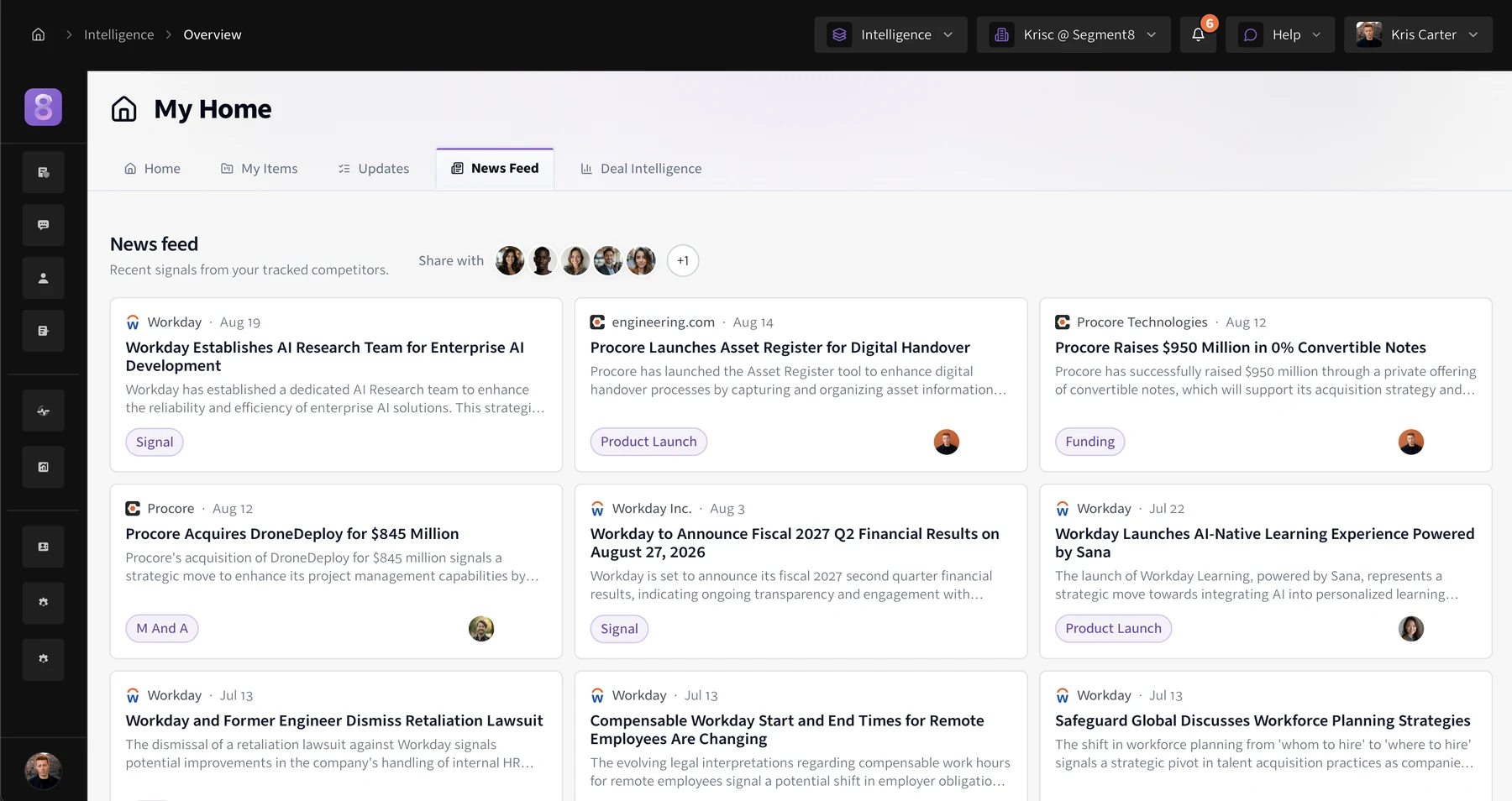
Segment8 connects the parts of GTM work that otherwise sit across separate systems.
Connect market and deal evidence
Competitive Intelligence monitors approved public sources, classifies material competitor activity, filters repeated coverage, and keeps the original source attached.
Deal Intelligence brings HubSpot or CSV opportunity outcomes into the same competitive view. Structured Win-Loss surveys add direct buyer evidence without pretending that a buyer response and a seller-entered CRM field are the same source.
The team can compare what changed in the market with what is happening in deals and what buyers say directly.
The value comes from keeping that evidence connected to the GTM work it may need to change.
Model real Go To Market work
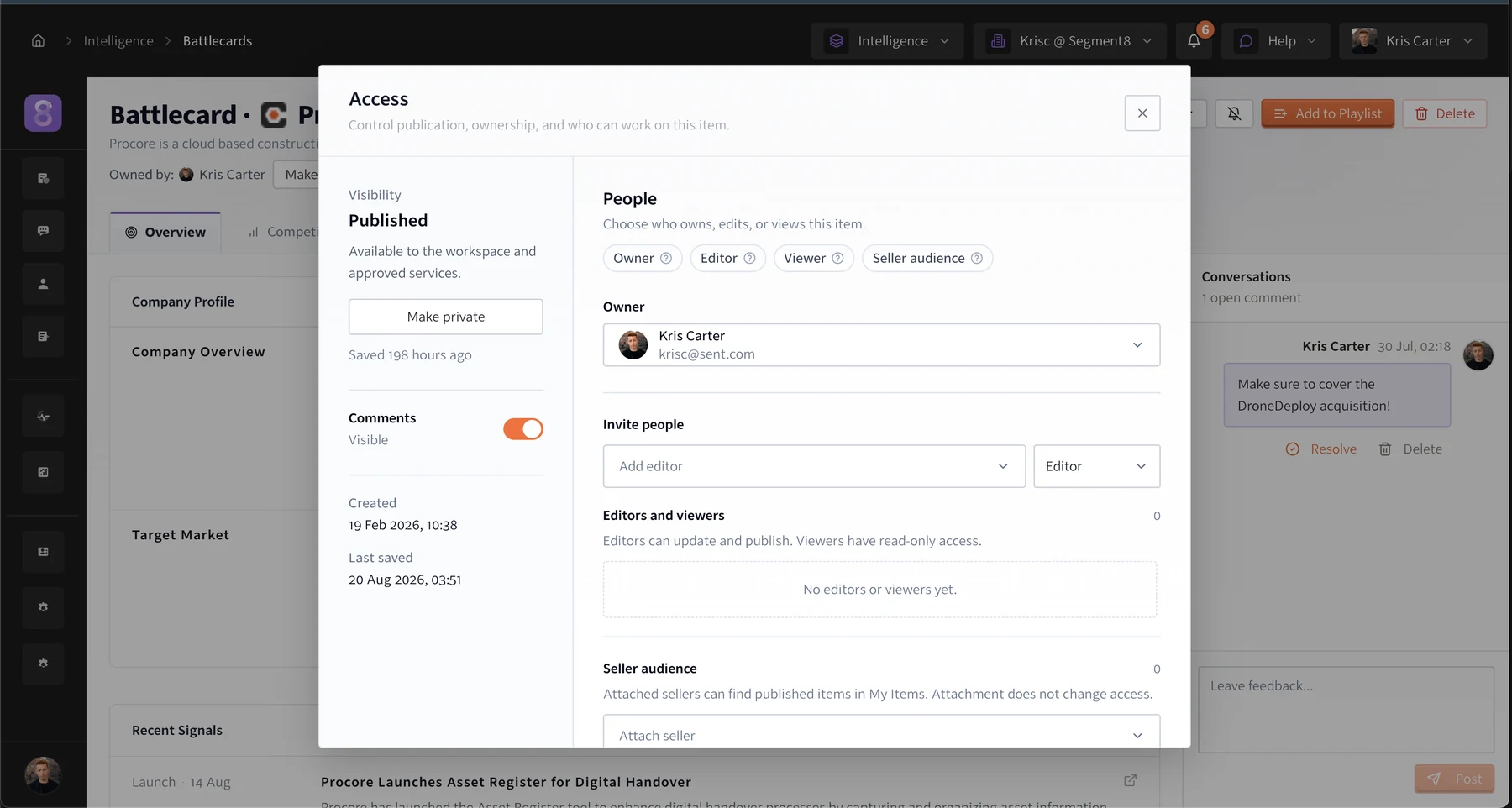
The work does not end in a generic task.
Segment8 models battlecards, messaging, personas, launch plans, playlists, owners, collaborators, managers, and seller audiences.
Workflow Automation keeps the evidence with the GTM work it should change. A manager can route a Work Assignment to the responsible person, set a due date, and see whether the work is open, waiting, overdue, or complete.
The software understands the GTM object and the work relationship, not only the task title.
Surface intelligence inside the product
Segment8 uses connected market and commercial context to highlight patterns and suggest where the team should review GTM work.
The suggestion appears beside the evidence and the affected object. Product Marketing still checks the source, decides what the company should say or do, and approves the result.
The product reduces the work required to reach the decision without hiding the basis for it.
Put current guidance where teams work
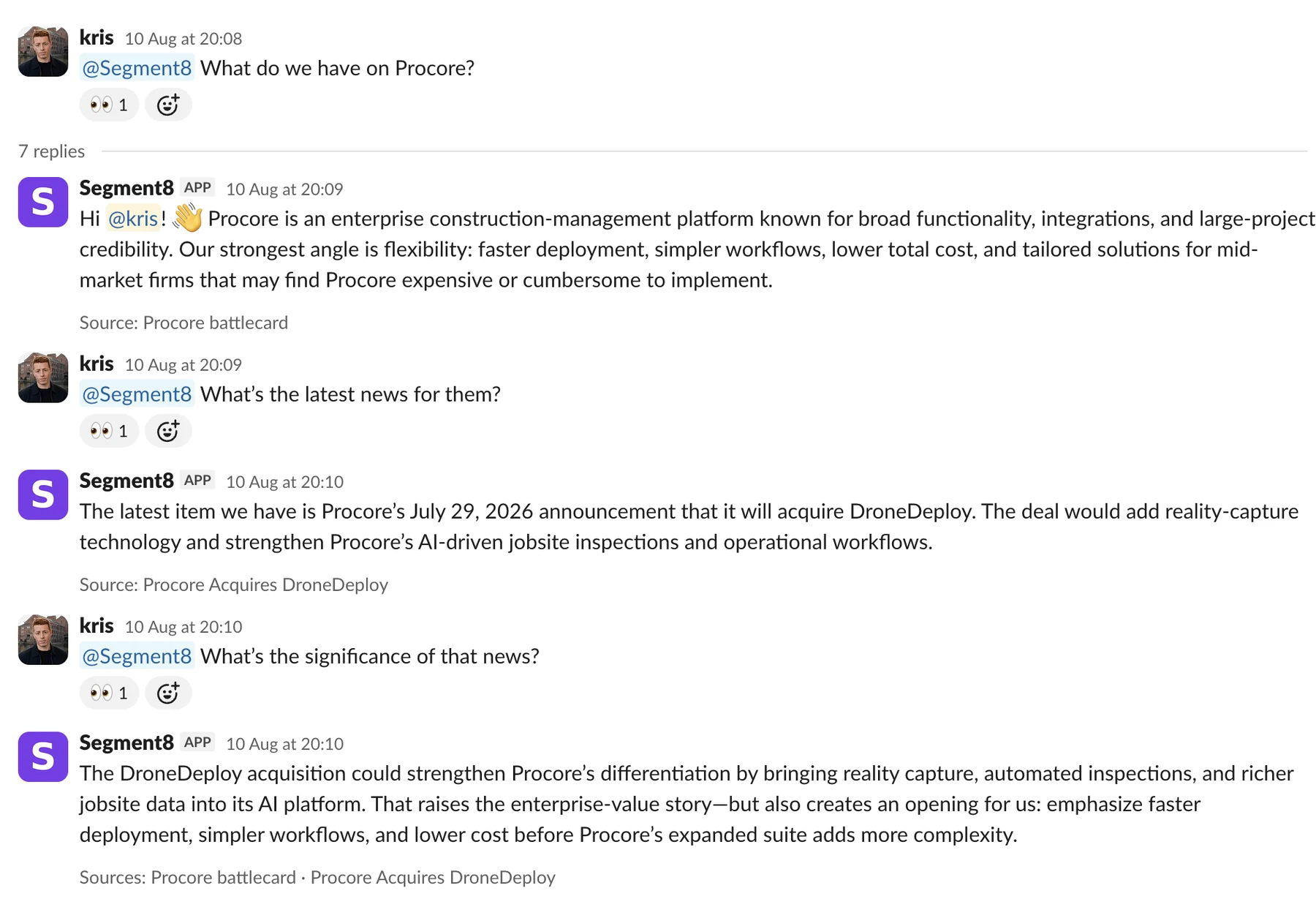
Multi-Channel Delivery puts approved guidance into Segment8, email, and enabled working channels.
Teams can share a sourced Signal with a workspace contact or an approved external distribution list. Assignment notifications and Recaps bring current work to the intended audience.
Sales receives current guidance without browsing another library or deciding which version is current.
How Segment8 differs from point solutions and horizontal tools
Existing GTM software, horizontal tools, and Segment8 solve different parts of the problem. The difference becomes clearer when you look at the records each system holds and what happens after that record is created.
| System | Primary record | Question it answers | How it fits into GTM work |
|---|---|---|---|
 Segment8 Segment8 |
Connected GTM context | What happened, who needs to act, and what should happen next? | ✓ Brings market intelligence, buyer evidence, deal outcomes, messaging, launches, enablement, owners, reviews, and field delivery into one connected workflow. |
| CRM | Account, opportunity, activity, and outcome | What happened in pipeline? | × Stops at the pipeline record. The team still has to connect outcomes to market movement, buyer explanations, positioning decisions, and the response used in subsequent deals. |
| Revenue and conversation intelligence | Pipeline analysis and recorded conversation | What happened in the deal or what was said? | × Stops at deal and conversation evidence. The team still has to connect it to the wider market picture and the GTM work it should change. |
| Competitive intelligence | Competitor and market Signal | What changed in the market? | × Stops at the market change. The team still has to connect it to CRM outcomes, buyer feedback, product context, launches, battlecards, and seller guidance. |
| Sales enablement | Content, training, and coaching | What should sellers access or learn? | × Distributes content, training, and coaching without maintaining the evidence and decisions that explain why guidance needs to change. |
| Knowledge bases and documents | Document and company information | What has the company written down? | × Stores company information without modeling the relationships between GTM activity, evidence, decisions, teams, assets, and outcomes. |
| DIY "Context Brain" | Documents, AI context, prompts, and layered skills | What can AI find, analyse, or draft from the context we have assembled? | × Depends on the team maintaining the documents, instructions, connections, permissions, and skills. It does not provide a GTM-native model for ownership, review, or delivery. |
Point solutions stop at their category boundary
Point solutions are useful when the work begins and ends inside one category.
A competitive intelligence platform can monitor competitors and maintain battlecards. A Win-Loss product can collect buyer evidence. An enablement platform can govern content and training.
The gap appears when the result needs to change work outside that system.
Product Marketing may still need to compare a finding with CRM outcomes and buyer research, decide which message, persona, launch, or battlecard changes, route the work through the right manager or contributor, and deliver the approved result to Sales.
Segment8 connects those steps in the same GTM model.
The same distinction applies to a DIY "Context Brain" built from documents, AI context, prompts, and layered skills. It can help a team find information, analyse a supplied context, and draft an answer. It does not maintain an up-to-date view of the market by itself, so the team has to supply the latest signals and it tends to react after someone notices a change. The team still has to maintain the source material, define the connections between GTM objects, manage permissions and authority, assign the work, run reviews, and deliver the approved result. Segment8 provides those relationships as part of the product.
Horizontal tools can coordinate work, but the GTM model is still yours to build
Project tools and flexible workspaces can model almost any process.
A team can create databases for competitors, products, launches, battlecards, personas, owners, review states, and seller audiences. It can create templates, permissions, and automations around them.
At that point, the team is building and maintaining its own GTM management system.
Segment8 makes GTM context product state
Segment8 supplies that structure as part of the product. Competitors and sources, CRM outcomes, buyer evidence, battlecards, messaging, personas, launches, owners, reporting relationships, seller audiences, review state, and delivery history remain connected.
AI works inside that model. It can help classify a market change, surface a commercial pattern, or suggest where work needs review.
The source remains visible, the authorised person makes the decision, and the approved result moves through a governed workflow.
The difference is not access to a language model or another task system. It is the GTM operating model around the work.
What changes for the GTM team
The value comes from a clearer path from evidence to decision, ownership, and execution.
- Revenue leadership can see where market, buyer, and deal patterns affect the business, then see what the team is doing about them.
- Product Marketing can review the evidence, decide what changes, and update messaging, positioning, launches, or guidance without rebuilding the workflow.
- Revenue Operations can keep commercial evidence mapped and current so the organisation acts on the same underlying context.
- Managers can see what work is open, who owns it, and which decisions are waiting for review.
- Sales can receive the approved answer and use current guidance before the next customer conversation.
Each team works from the same GTM context while retaining its own authority and responsibility.
Built for scaling technology companies
Segment8 is shaped by first-hand experience across Product Marketing, Sales, and Revenue teams. We have seen useful market and deal evidence spread across specialist products, spreadsheets, documents, Slack threads, and people’s heads.
The problem was a lack of a system built around the way GTM teams connect evidence, make decisions, assign work, manage reviews, and deliver the result.
That is why Segment8 connects market activity with CRM and buyer evidence, models native GTM work and relationships, manages ownership and review, and delivers approved guidance through daily-use channels.
See the Segment8 platform, or follow one connected GTM workflow in the product walkthrough.