
A product marketing leader at a company of nearly 1,000 people built his own PMM operating system. It lives in AI projects, shared skills and Markdown files. The projects hold the source material, and the skills turn it into pitch decks, briefs and other sales content. A small team supports a broad product range. Around 200 colleagues use the shared messaging skill, with several hundred uses in a month, and the team rebuilt much of its solution-page content in a few weeks.
The appeal is obvious. Sellers get a quicker answer, Product Marketing stops repeating the same brief, and more content comes from one shared message.
The hard part starts when that message changes. A shared skill makes the answer easy to produce, but the business still needs a system that keeps the answer right. That system has six requirements, and each one is a job someone has to do.
The first version failed where the work met the people
His first attempt used a developer workflow. Marketers were expected to propose changes through a code repository and submit them for review. They didn't want to work that way, so he replaced it with projects and skills inside the AI tool.
That was the right call. Product Marketing needed shared context and a repeatable way to create content, and software-development habits added work between the person and the result.
But the repository had been doing a job besides being awkward. It decided which source was current, who could change a message and who reviewed the work. Moving to a chat window removed the friction and left those responsibilities in place. They now live in instructions, conventions and manual checks that the team has to maintain. This is where a useful internal tool starts turning into another product that Product Marketing has to run.
One bad proof point can travel through the whole company
The setup included a clear rule: use approved references. With many people generating from one source, that rule matters, because a wrong claim in the source gets repeated across decks and briefs faster than a small PMM team can inspect them.
Take a proof point that stops being current. The source changes, but a seller has already used it in a presentation. A colleague has built a regional version, and a third person has pasted the wording into an account brief.
Updating the source improves what gets produced next. It doesn't identify the material already out in the market, assign anyone to correct it or record who reviewed the new claim. "Approved references only" is an instruction, and what's missing is a process with owners, review decisions and a clear account of which version is ready for use.
The success of the shared skill makes this more urgent. Adoption increases the reach of good messaging, and it increases the reach of a mistake by the same amount.
A deck can look right and still say the wrong thing
The setup also used a brand skill to keep generated documents consistent. Consistent fonts, colours and layouts help a company present itself well. They say nothing about whether a product claim is current, whether the proof applies to this buyer or whether the wording is approved for this use.
A polished deck can carry an old number. A correctly formatted brief can use proof from the wrong region, and a clear, confident sentence can overstate what the product does.
So the question is what a reviewer actually checked. It could have been the product facts, the buyer message or both, and the approval may pre-date a later edit to the claim. A file can describe the review process, but the working system has to carry it out and keep the result. That matters most when Sales is using the material in real deals, where the business needs a known, reviewed answer that someone is responsible for maintaining.
Every product, region and buyer adds another decision
The leader also found that one global message wasn't enough. Sellers in different regions needed proof that made sense in their markets, and without it they went back to their own material.
Consider a business with ten products, four regions and three main buyer roles. That's 120 possible product, region and buyer combinations. It doesn't mean 120 decks, but it does mean someone must decide what can be shared and where the answer needs to differ. Someone has to know which claims are global and which proof is local, who can change regional wording and who reviews a change that spans products.
Adding a file gives the model more context. It also creates content whose scope and ownership the business has to understand.
Competitive messaging has the same shape. Grouping competitors into broad types helps a team explain the market, but a live deal can turn on the details of one named competitor's offer. Product Marketing needs a way to connect that specific evidence to the response Sales uses. A growing company has to manage these relationships deliberately, or the system depends on a few people remembering how the parts fit together.
Maintenance becomes a second job for the PMM team
The shared skills reportedly stayed useful because the owner updated them regularly, and people trusted the system because they could see someone maintaining it. That creates an ongoing commitment.
A competitor changes its offer, a product team changes a capability, a buyer raises a concern the current message doesn't answer, a region needs different proof, or a reviewer asks for a rewrite. Each event creates several jobs. The research needs checking and the message needs updating. A battlecard may need new proof and a launch may need different material, and Sales needs the approved answer.
At a small scale, the person who built the setup knows what to do and whom to ask. As more people and products depend on it, that knowledge is hard to keep in one head, and it walks out the door if the owner changes roles. The team needs to see the work itself: the reason for the change, the owner, the instruction, the due date and the review still required.
That's the limit of treating a collection of files as the operating system. The files hold the content, and the team still has to build and run the process that keeps it useful. Skills can include scripts and other resources as well as instructions, so the tools can support elaborate systems. Every extra rule and connection still needs an owner to build and maintain it.
Usage tells you people opened the door
The account described usage tracking through skill analytics. It didn't describe a separate measure of output quality.
Several hundred uses a month show that people are using the tool. They don't show whether the right proof reached the right buyer, whether reviewers checked the claim or whether an old answer is still in active deals. A sales team can adopt a tool and still carry inconsistent guidance into the market, and a busy content system can produce more material while making the review burden harder to manage.
Product Marketing needs a clearer account of the work behind the answer. That means what changed, which content the team reviewed, who made the decision, which version is ready and who should receive it. Without those answers, usage becomes an encouraging number that says little about the guidance Sales receives.
The token bill leaves out the work around the files
The reported AI spend was roughly $200 per product marketer per month. That prices the model usage. It doesn't price maintaining the source library, resolving regional differences, checking claims, routing reviews, managing access or coordinating updates.
The people doing that work are usually the same small team responsible for launches, positioning, buyer research and sales support. Their time belongs in the build-or-buy decision, and so does the cost of keeping the setup running when its original owner moves on. A low generation cost can make the system look cheap while the coordination work stays scattered across people and tools. The useful comparison is the cost of completing the whole product marketing job.
That is the real buying decision: how much of the product marketing system does the business want its PMM team to build for itself?
What this work looks like in Segment8
Taken together, the six problems point to four requirements:
- An owner for every message and battlecard
- A source trail from competitor activity, deal results and buyer feedback to the claim
- A review record showing who approved which version, with re-approval after edits
- Controlled delivery, so Sales gets the approved answer and only that
Segment8 is built around the work between evidence and the answer Sales uses. It connects competitor activity, HubSpot or CSV deal results and direct buyer feedback to positioning, messaging, personas, battlecards and launch plans. Your team can investigate a finding and prepare the response in the same system.
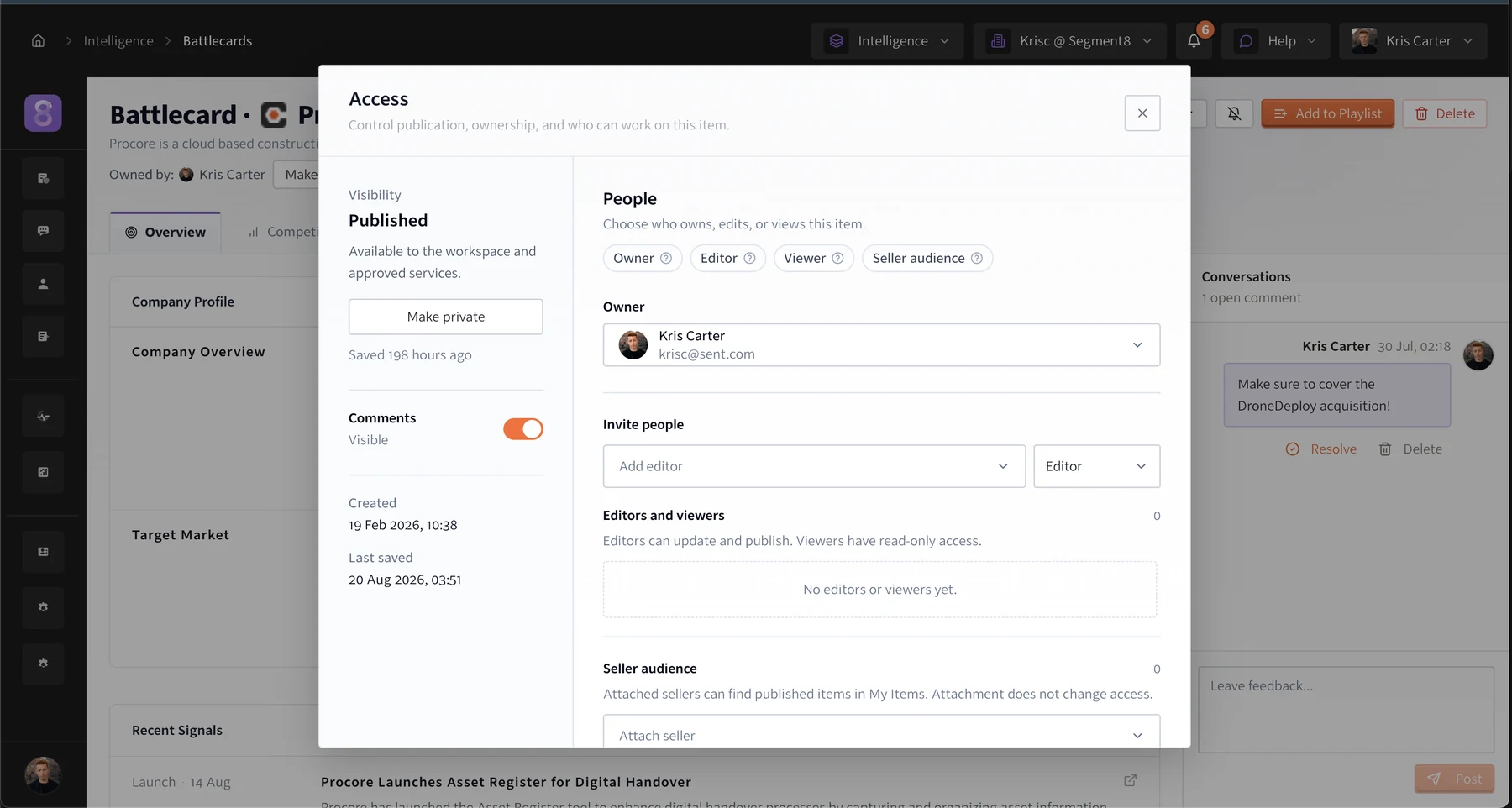
Ownership. A selected market finding becomes an assignment with an owner, an instruction and a due date. The person receiving it can see what prompted the request and what they need to produce, and managers can follow progress.
Review. Reviewers can approve or request changes, with notes kept for the owner. Managers choose the reviewers, require all or a set number of approvals, and require new approval after edits. The approval view shows the content version, the decisions required and who is currently responsible. The interface flags content changed since approval, and the history retains decisions and handoffs.
Delivery. The seller audience is separate from editing and publishing rights. Product Marketing can make the approved answer available to Sales while keeping responsibility for maintaining it clear. Playlists bring approved guidance and exports together for a product, launch or sales situation.
These are capabilities your team can use, not business rules it must first design around a file library.
Follow one claim through the whole response
Imagine a competitor changes a package and your battlecard needs a new answer.
Product Marketing inspects the original source, reviews the relevant deal results and uses buyer research to understand the concern, then decides what the message needs to explain. An owner receives the update with an instruction and a due date, and colleagues help prepare the claim and proof. The battlecard enters approval, where reviewers can ask for changes and record the reason.
If the finding affects a launch, the team coordinates the related message, owners, dates and assets in the launch plan. The approved material is packaged into a seller playlist and shared through Segment8, email or enabled working channels.
At the end there is a source, a decision, a responsible person, a review and guidance prepared for a defined audience. That's what a company approaching 1,000 people needs to run reliably, and generating the next deck is one step inside it.
Stop making Product Marketing build its own operating system
The reported setup shows how much demand there is for shared product context and quicker answers. It also shows how much work sits around the generation step: someone owns the sources, the content, the review and the next change, and someone keeps Sales on the approved guidance.
Your PMM team should own those decisions. It shouldn't also have to build the software that records and runs them.
Bring one messaging update to a Segment8 demo. Follow it from the source through the owner and review to the answer Sales receives.